Lilliana
Last ChristmasLilliana is a human healer whose decision to approach a wounded enemy establishes the compassion and moral independence that shape her bond with Malphas. Their first meeting places her face-to-face with the demon he believes he must fight, but she answers his threat not with a call for reinforcements, but with an offer of help.
Identity and First Meeting
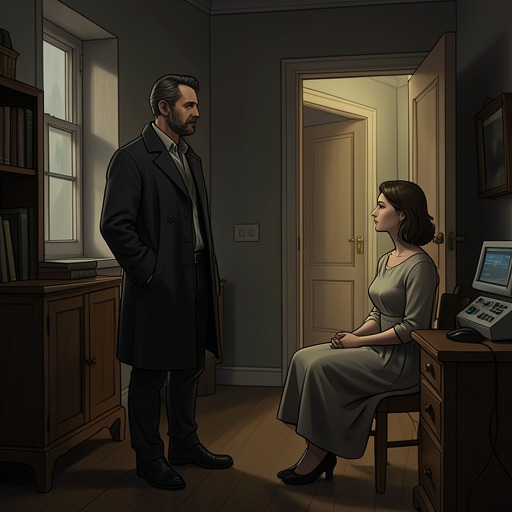
When Lilliana encounters Malphas, he is at peace until her sudden gasp alerts him. He rises with his sword angled to behead whoever has disturbed him, expecting a human enemy. Instead, he sees a frightened woman with celestial-blue eyes, white-blonde hair drawn into a thick braid, and loose strands curling against her pale skin. Her face is described as pixie-like, with a slightly large nose that Malphas regards not as a blemish but as part of her beauty. Though visibly afraid, she approaches slowly and cautiously.
Malphas bares his fangs and hisses, trying to frighten her away. Lilliana freezes, but holds her ground: she identifies herself as a healer, points to his wound, and offers to help if he will allow it. Her offer runs against the history between them. She is human, he is a demon, and his kind has slaughtered humans by the thousands; Malphas privately recognizes that he himself has killed hundreds of people like her. He also knows that if others find him, they may summon help to kill him, while any fight could cost them dearly.
Instead of calling for others, Lilliana explains that Malphas has done her no harm and poses no threat to her at that moment. She will not hold one person accountable for the deeds of others, insisting that judgment should rest on what he himself has done. Her principle is not based on ignorance of danger: she approaches despite her fear and despite the threat he presents. Yet Malphas knows that her judgment might change if she learned the full extent of his past. When he asks her name, her frown gives way to a striking smile; she tells him she is Lilliana, then disappears into the daylight.
Love, Loss, and Return
Malphas’s attachment to Lilliana becomes explicit when he asks her to marry him. He steps in front of her, takes her hand, and kisses her palm as he makes the proposal. Lilliana is startled, unsure she has heard him correctly; the scene establishes the depth of his commitment, but the moment itself does not record her answer.
That promised future is shattered by an attack. When Malphas reaches the scene, smoke, burning flesh, screams, blood, and mangled bodies surround him. He searches among the victims, calling for Lilliana and hoping she is alive. Finding her, he drops to his knees, gathers her body into his arms, and sobs. His anguish turns the loss into a crisis of survival: he cannot understand why she is gone, or why he remains alive without her.
The grief persists across an immense stretch of time rather than fading into the past. Much later, among friends and their families gathered together, Caleb feels out of place. Their happiness recalls a joy he once knew with Lilliana, but it also sharpens his sense of absence. He understands that she remains with him in his heart, at once his greatest treasure and his greatest pain. Seeing others gathered in loving families does not soothe him; it makes the life he lost newly present, and leaves him questioning why he has continued to live.
That long separation ends when Caleb sees Lilliana again, a person he never expected to meet. She approaches hesitantly, and he is overwhelmed by tears as she reaches toward his whiskered cheek. The touch he has yearned for over thousands of centuries becomes possible again. When he feels her steady pulse, he recognizes that she is physically present, though her return is bound up with a mystery: she remembers trying to protect children from an approaching demon army, then waking in their cave beside a man who resembled Caleb but had different-colored eyes. He told her she had slept enough and that Caleb needed her. Lilliana cannot explain what happened, and the account offers Caleb a clue without resolving the mechanism of her return.
Caleb promises to spend whatever time remains showing Lilliana how deeply he missed her and to keep anyone from harming her again. She answers with a promise of her own: he will never be alone. Their reunion therefore does not erase the years of bereavement or the violence that separated them. Instead, it brings the enduring bond into the present, turning what had been a source of pain into a relationship they can again affirm together.
Narrative Role and Thematic Significance
Lilliana’s defining ethical stance is presented before she knows the full measure of the person she is helping: she refuses to judge someone solely by the deeds of his people, while Malphas privately knows how much his own past could complicate that principle. The gap between what she can see in the wounded stranger and what he knows about himself makes her compassion consequential rather than merely gentle. Her response does not erase the history of violence between humans and Demons; it insists that individual conduct still matters within it.
The story also gives her bond with Malphas a vocabulary that survives changes in circumstance and identity. In the proposal scene he addresses her as Lil, while the much later reunion places Caleb beside the familiar endearment of her beautiful demon. These names hold together the warrior she first encountered and the companion whose absence shaped his long grief. Her return does not make the intervening loss disappear; it allows the relationship that endured within Caleb to become present between them again.
The Unfinished Return
The reunion ends not with an explanation of Lilliana’s return but with her turning Caleb toward a shared memory. After he promises to protect her and she promises that he will never be alone, she asks whether he remembers the day he went to battle. The question shifts the scene from the relief of recognition toward the past that preceded their separation; the narrative stops before Caleb answers. Her return is therefore both an emotional resolution and an open threshold: she is present again, but how she came back—and what the memory will disclose—remains unsettled.